
Richmond County Directory Holdings
Augusta’s historical shelf is unusually deep. The Georgia Heritage Room at the Headquarters Library keeps Augusta city directories from 1841 to the present, although some editions before 1870 are missing. The room also holds local census microfilm, newspapers, yearbooks, family histories, cemetery indexes, and funeral-home material. These sources let a reader check a directory name against a second record made for a different purpose.
| Collection | Years | Where Held | Access |
|---|---|---|---|
| Augusta city directories | 1841 to present, with gaps | Georgia Heritage Room | Early volumes on microfilm; recent decades in books |
| Personal-name indexes | 1841–1902 | Georgia Heritage Room | Onsite or focused staff request |
| Business indexes | 1841–1930 | Georgia Heritage Room | Onsite or focused staff request |
| Federal census microfilm | 1820–1930 locally | Georgia Heritage Room | Onsite; public federal census extends through 1950 |
| Augusta Chronicle | 1792 to present | Library database and microfilm | Remote database for Richmond County PINES cardholders |
| Rural Directory, MS 92 | Date not stated in finding aid | Georgia Room Archives | Ask staff about arrangement and access |
The exact contents change by edition. Alice O. Walker’s Catalog of the Augusta (Georgia) City Directories: 1841–1939 is the local finding aid for learning what survives in a given year. Do not fill a missing year with a guess. Check the catalog, nearby editions, the census, and newspapers. The library has not verified a complete public full-text run online, so microfilm and bound books remain central access channels.
The library’s Augusta city directory description shows how the run, indexes, and formats fit together.
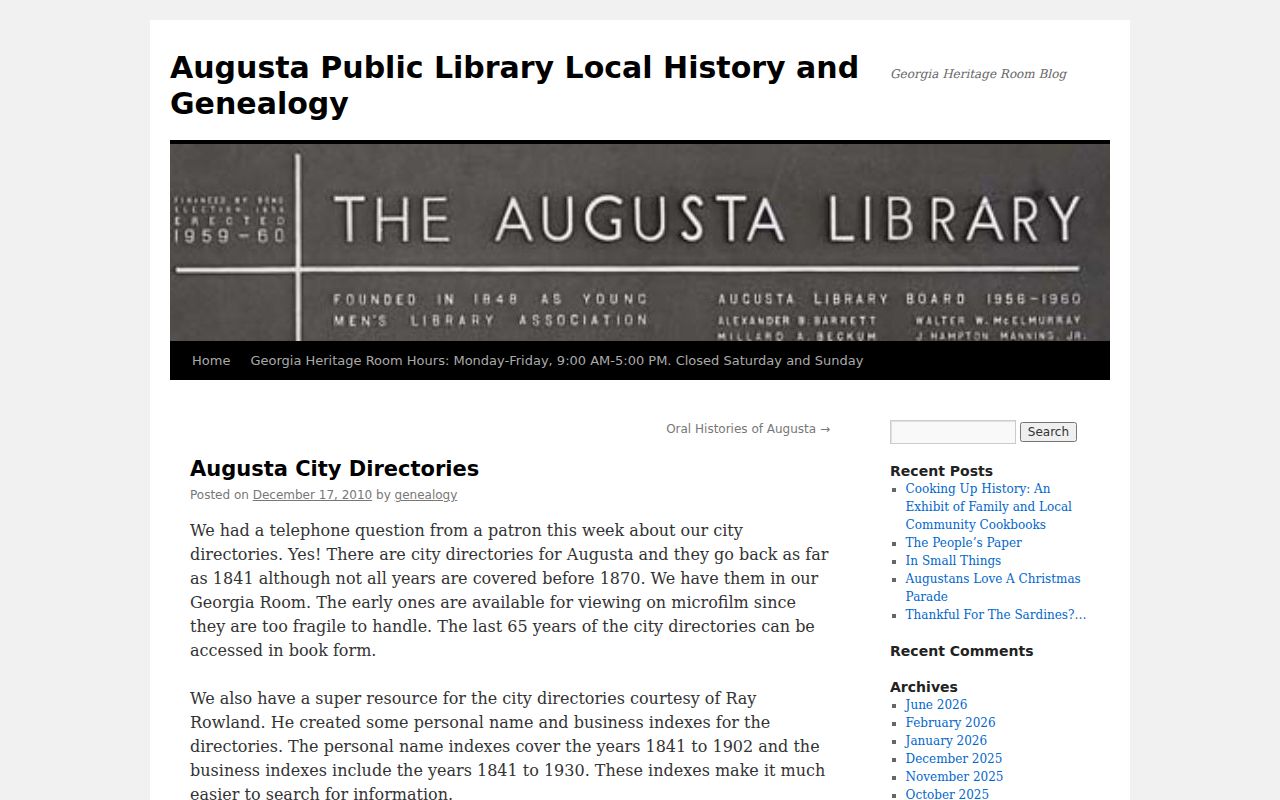
The captured collection page is a useful citation point before requesting a particular year or format.
Access Augusta City Directory Shelves
The Georgia Heritage Room is on the third floor at 823 Telfair Street in Augusta. Current hours are Monday through Thursday, 10:00 a.m. to 5:00 p.m., and Friday, 10:00 a.m. to 4:00 p.m. Call 706-826-1511 before a long trip. Its materials do not circulate. Fragile books cannot be put on the copier, but photography and notes are allowed when handling rules permit. Black-and-white copies cost 25 cents per page and color copies cost $2 per page.
Remote researchers can request a $5 ready-reference check for one name in one to five directory years. Staff guide research but do not build a full family tree. A strong request gives the full name, spelling variants, likely years, and any known address. It also asks for the edition, page, and exact transcription. The current page confirms the base charge; older posted add-on prices should be checked before ordering more years.
The Georgia Heritage Room access page gives current hours, services, and collection rules.

This source should be checked for current desk details before visiting or sending a paid lookup request.
Note: Older blog posts show different hours, so use the library’s current main page rather than an archived schedule.
Augusta Directory Indexes by Name
Ray Rowland’s local indexes save time in the earliest city directories. The personal-name index spans 1841 through 1902. A separate business index runs from 1841 through 1930. Start there when a surname or firm is known but the edition is not. The index is a pointer, not the final proof. Pull the original page and preserve the entry exactly, including initials, spelling, address, and any mark explained in that volume’s key.
Business entries can add a proprietor, trade, or work address, but they do not prove a home address. Compare a firm listing with the personal-name section. Then check the street section when the edition has one. This three-way reading can separate two people with similar names and can reveal that a residence and a shop were at different locations.
| 1841 | Earliest year in the local Augusta directory run |
|---|---|
| 1841–1902 | Ray Rowland personal-name index span |
| 1841–1930 | Local business-index span |
| 1872 | Beginning of stated African American representation |
| Recent decades | Roughly the last 65 years are served in bound-book form |
Richmond County Directory Gaps
Nonappearance is not proof that a person left Augusta. Annual coverage is incomplete before 1870, and African American residents begin to be represented only in 1872. That limit is part of the record’s history. It can make the same search method work well for one household and fail for another. Name spelling, the timing of a canvass, and omitted residents add more uncertainty.
When a person is absent, search one year before and after. Then use released census schedules, newspapers, funeral programs, cemetery indexes, deeds, or probate material. A directory was a published snapshot, and its publication date may lag the canvass date. State conclusions with the edition year, and describe a gap as a gap.
Coverage matters. An absent pre-1872 African American resident must never be treated as evidence that the person was absent from Augusta.
Decode a Richmond County Entry
Read the front matter before copying an Augusta entry. A typical line begins with a surname and given name or initial. Some editions add a spouse in parentheses, an occupation or place of work, and a residence. A business address may appear apart from the home. Some volumes mark owned or rented property. Widow notation can be a useful lead, but the exact symbols and short forms must come from that edition’s key.
| Name | Surname, given name or initial; spelling may shift by year |
|---|---|
| Spouse | Named in some editions, often in parentheses |
| Work | Occupation, profession, and sometimes employer |
| Address | Residence number and street; business address may be separate |
| Tenure or status | Some editions show owned/rented status or widow notation |
- Criss-cross directory
- An address-first arrangement that lists entries by street and house number instead of by surname.
- Householder index
- A list centered on the named person responsible for a household entry, which may omit other people living there.
- Abbreviation key
- The edition’s own guide to shortened occupations, status marks, and address terms. Copy it before interpreting symbols.
Inspect adjacent entries and the street section when available. Nearby same-surname names may be relatives, but the page alone does not prove kinship. Keep residence and work fields separate. If an entry says a person boards at an address, transcribe that fact without changing it into ownership.
Augusta Directory Companion Records
The library’s genealogy channels can extend a city directory find. Ancestry Library Edition is available on library computers or Wi-Fi. HeritageQuest is offered remotely through GALILEO with a valid PINES card. The Georgia Room is also a FamilySearch Affiliate Library, so some locked digital images can be viewed onsite. The Chronicle database reaches from 1792 to the present for Richmond County cardholders.
The local Augusta Vital Records Database indexes major Chronicle notices from 1982 through 2009. The Augusta genealogy portal also points toward local databases and research help.
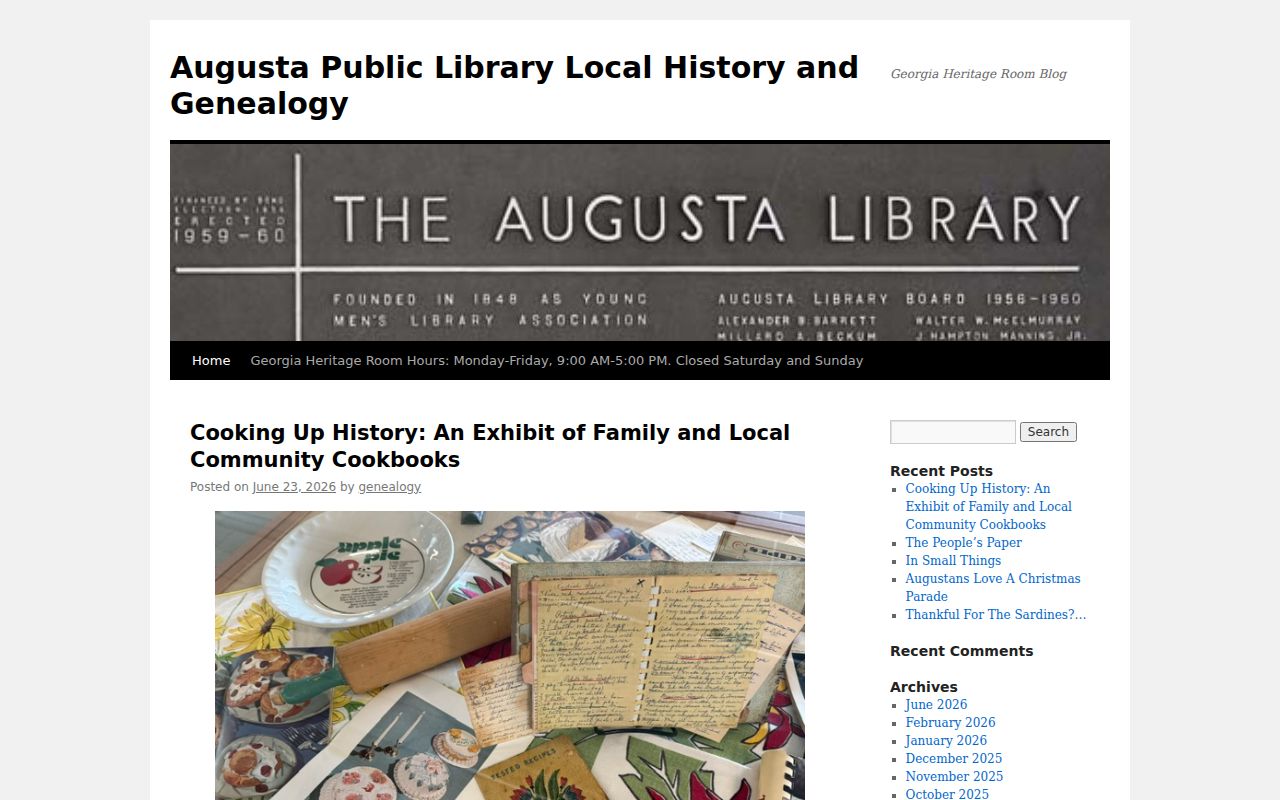
Use these finding aids to locate the newspaper, census, funeral, or cemetery record that can confirm a directory interpretation.
Other local layers include high-school yearbooks, the Elliot Funeral Home Index, digitized African-American funeral programs, the WWI Veterans of Richmond County database, and the Graveside Project. Each has its own scope. Cite the source that actually supplies the fact.
Richmond County Archive Finding Aids
The Georgia Room Archives adds manuscript collections that do not fit the standard city directory run. MS 92, the Rural Directory of Richmond County, is listed in the finding aids, but its date and arrangement are not stated. Ask staff before describing its contents. The archive catalog is the proper first step for access conditions and related collections.
The Georgia Room finding-aids page documents that archival route.

The image confirms where to begin, while staff can supply the missing date, arrangement, and handling terms for a specific manuscript.
Trace Family Through Augusta Directories
Begin with a known year or address, then move through nearby editions one at a time. This catches short moves and spelling shifts that a decade-to-decade jump can miss. Pair the annual evidence with a released federal census. The Georgia Heritage Room has census microfilm through 1930, while federal public access now extends through 1950 under the 72-year release rule.
- Use the Rowland index for an early target, or start with the closest known directory year.
- Read the abbreviation page, then record the exact name, spouse, work line, home address, edition, and page.
- Check nearby names and the street section. Repeat in the years just before and after.
- Compare the matching census household, keeping the census date distinct from the directory edition.
- Use the Chronicle, probate files, funeral programs, and cemetery indexes to explain a last appearance.
A disappearance can mean death, relocation, remarriage, a street or boundary change, or simple omission. Newspapers and probate can explain death or estate transfer. Deeds can test ownership. Yearbooks may reconnect a classmate to a school and year, but do not by themselves establish later residence. For modern address-keyed work, use the Richmond County street directory rather than forcing an old volume to answer a current question.
Note: Keep edition year, publisher when shown, and page number with each transcription because directory dates can lag the original canvass.